
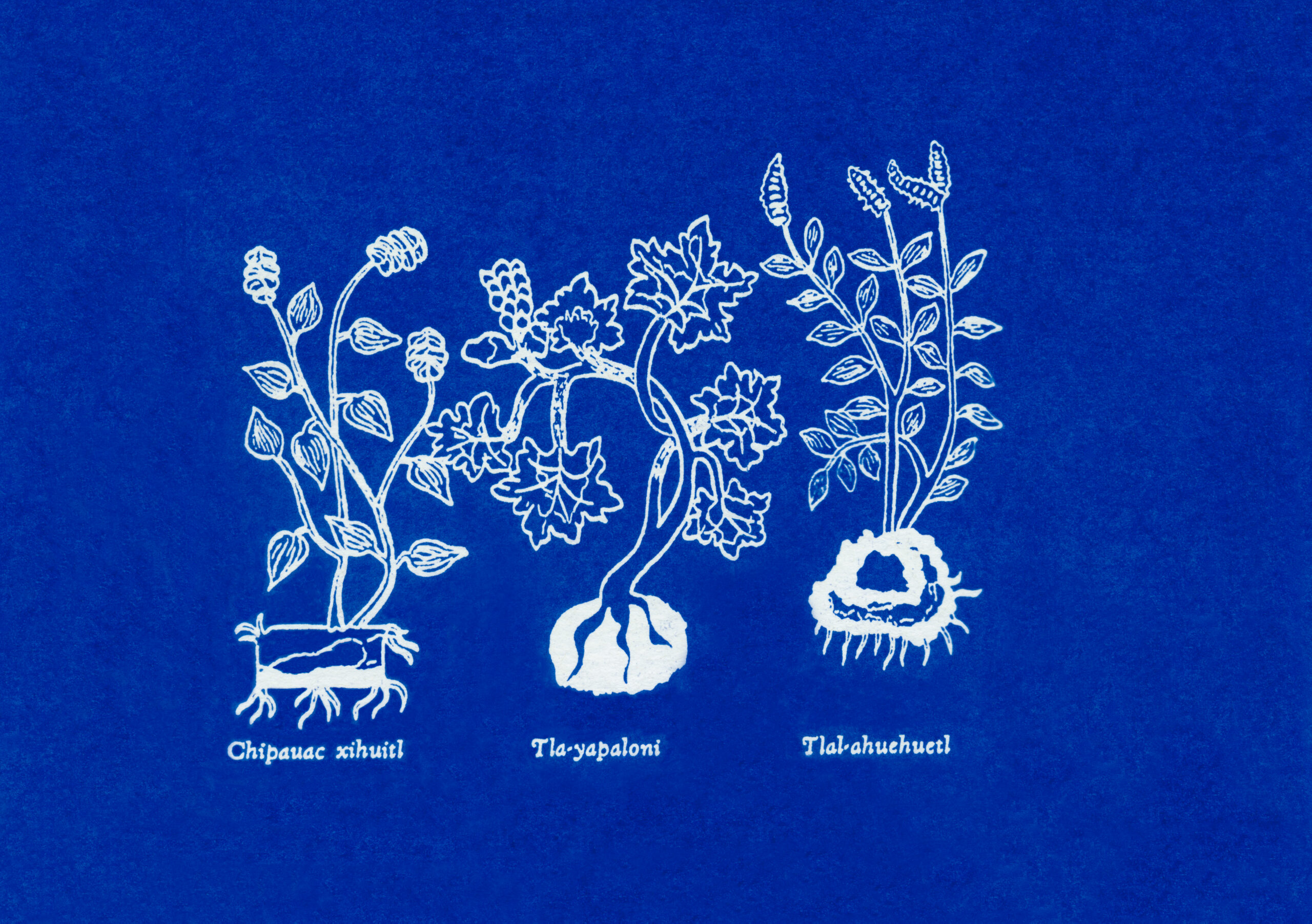
Cyanotypes and Herbalism: Art from Nature
Presenters: Cinthya Santos Briones
Location: Family Activity Tent
This workshop invites participants to explore image-making through cyanotype, a cameraless photographic process that uses sunlight and photosensitive compounds to produce images in deep blue tones. Participants will work with medicinal herbs—such as lavender, sage, and rosemary—to create botanical photographs on fabric and cotton paper, exploring the forms and textures of plants.
Illustrations from the Códice de la Cruz-Badiano, considered the first herbal of the Americas and written in the 16th century, will also be incorporated.
The workshop introduces the origins of this technique, invented in 1842, alongside its relationship to herbal practices. Surrounded by the aromas of plants, participants will create images that connect art and memory.
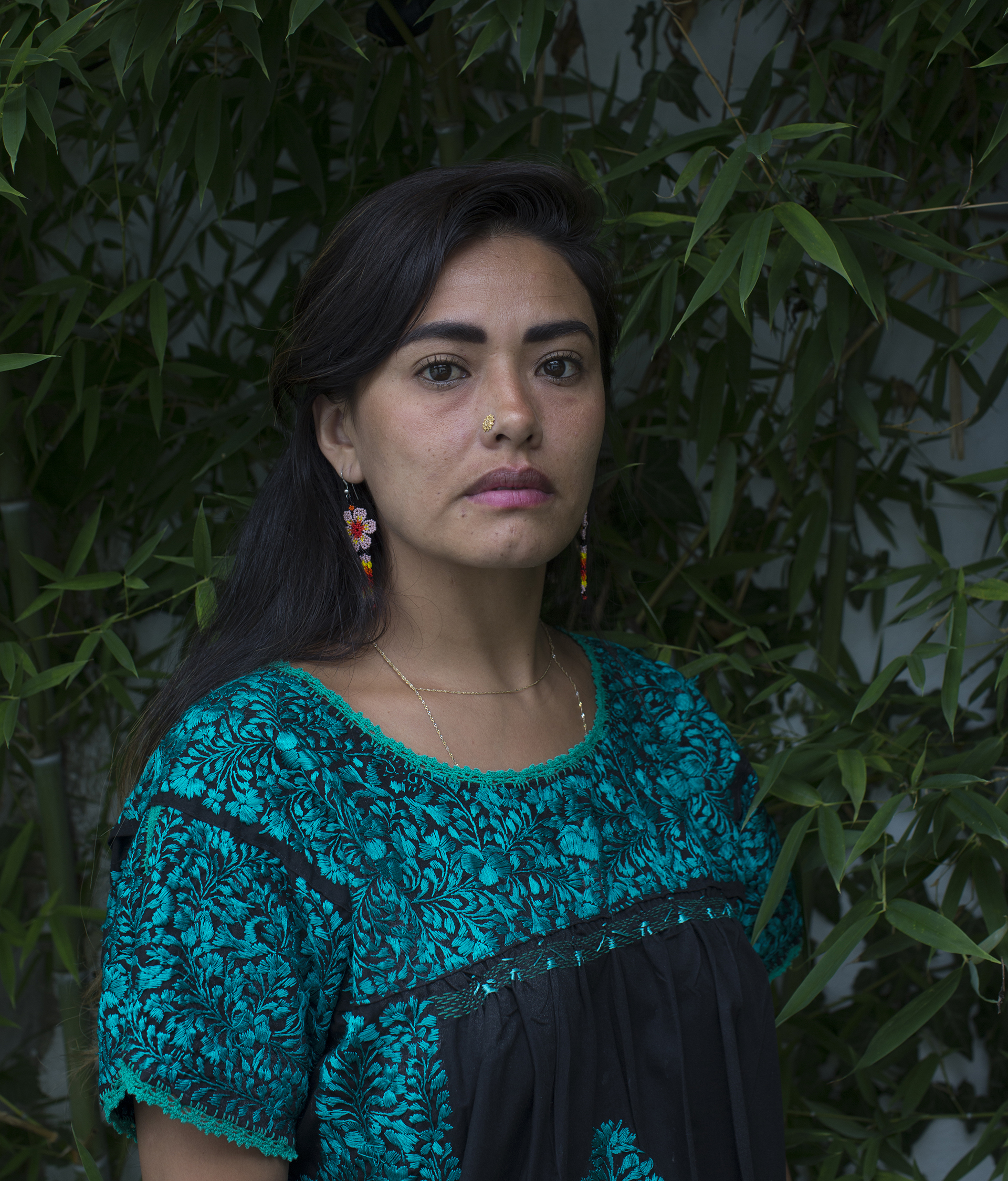
Cinthya Santos Briones is an interdisciplinary artist, researcher, and educator of Nahua Indigenous heritage based in New York. Trained in Ethnohistory and Anthropology, she spent over a decade conducting research at Mexico’s National Institute of Anthropology and History (INAH), focusing on Indigenous migration, codices, textiles, and traditional medicine. Her multidisciplinary practice engages participatory art and collective storytelling, weaving nonlinear narratives through photography, archival materials, writing, ethnography, drawing, collage, embroidery, and popular education. Her work centers community voices and fosters social engagement.
Cinthya holds an MFA in Creative Writing and Photography from Ithaca College, as well as a Certificate in Documentary Practice and Visual Journalism from the International Center of Photography (ICP). She currently serves as faculty in the Studio Arts Practice MFA program at the Institute of American Indian Arts (IAIA) and as Associate Director of Outreach and Partnerships at the Mexican Studies Institute. She has also been a guest artist at Columbia University and Rutgers University.
Her work has been supported by numerous fellowships, grants, and residencies, including the Magnum Foundation, En Foco, National Geographic Research and Exploration, We Women, City Artist Corps, Wave Hill House Winter Residency, the Mellon Artist Fellowship at the Hemispheric Institute of NYU, BRICLab Contemporary Art, Talk of the Town AIR at El Museo del Barrio, NYSCA, and the Indigo Arts Alliance Mentorship Residency, among others. She was also a finalist for the CPW Saltzman Prize and Emerging Photographer of the Year, New York (2026).
Her photography and writing have appeared in publications such as The New York Times, PDN, California Sunday Magazine, Vogue, Open Society Foundations, BuzzFeed, The Intercept, The New Yorker, and The Nation. As a writer, she has contributed to both academic and journalistic outlets, including NACLA, The Nation, and La Jornada.
Cinthya has exhibited her work in solo and group exhibitions at institutions including Sky Blue Gallery (Portland, OR), The Latinx Project at NYU, the International Center of Photography, El Museo del Barrio, the Museum of the City of New York, the Trout Museum (Wisconsin), the Paul W. Zuccaire Gallery at Stony Brook University, and MoMA PS1. She has also presented artist talks at institutions such as Columbia University, NYU, Boston College, CUNY, SUNY New Paltz, and Dutchess Community College.
She is co-author of The Indigenous Worldview and Its Representations in Textiles of the Nahua Community of Santa Ana Tzacuala, Hidalgo and co-creator of the documentary The Huichapan Codex.
In addition to her artistic practice, Cinthya has worked as a community organizer with pro-immigrant organizations in New York, addressing issues related to detention, education, and sanctuary. She has also volunteered to accompany migrants to immigration court and asylum proceedings, and serves as a guardian for unaccompanied migrant children.
Cinthya is a member of Colectiva Infancia, a collective of anthropologists engaged in ethnographic and visual research on childhood, migration, violence, urban studies, and epistemologies of the Global South.
This website was made possible thanks to the generous support and partnership of