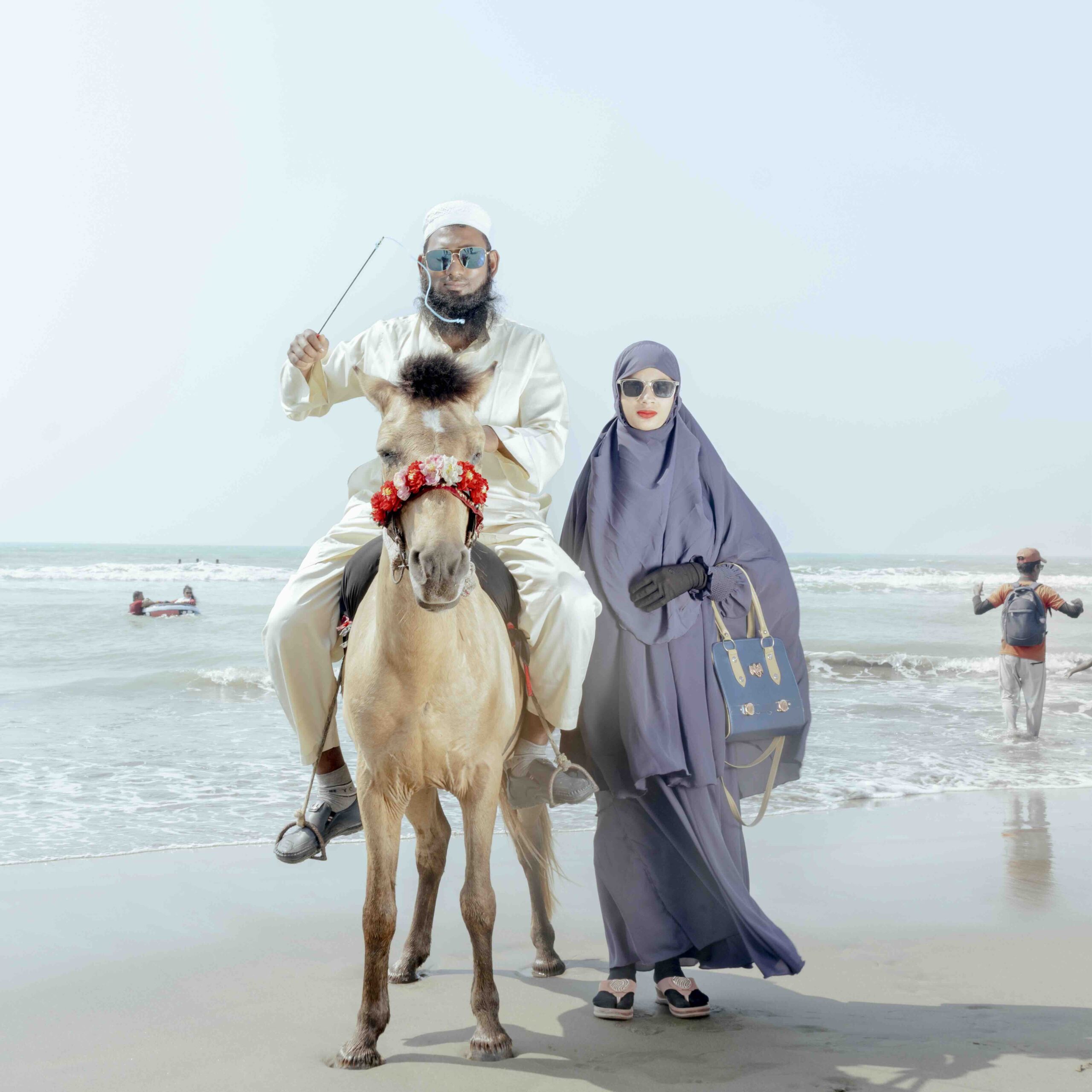
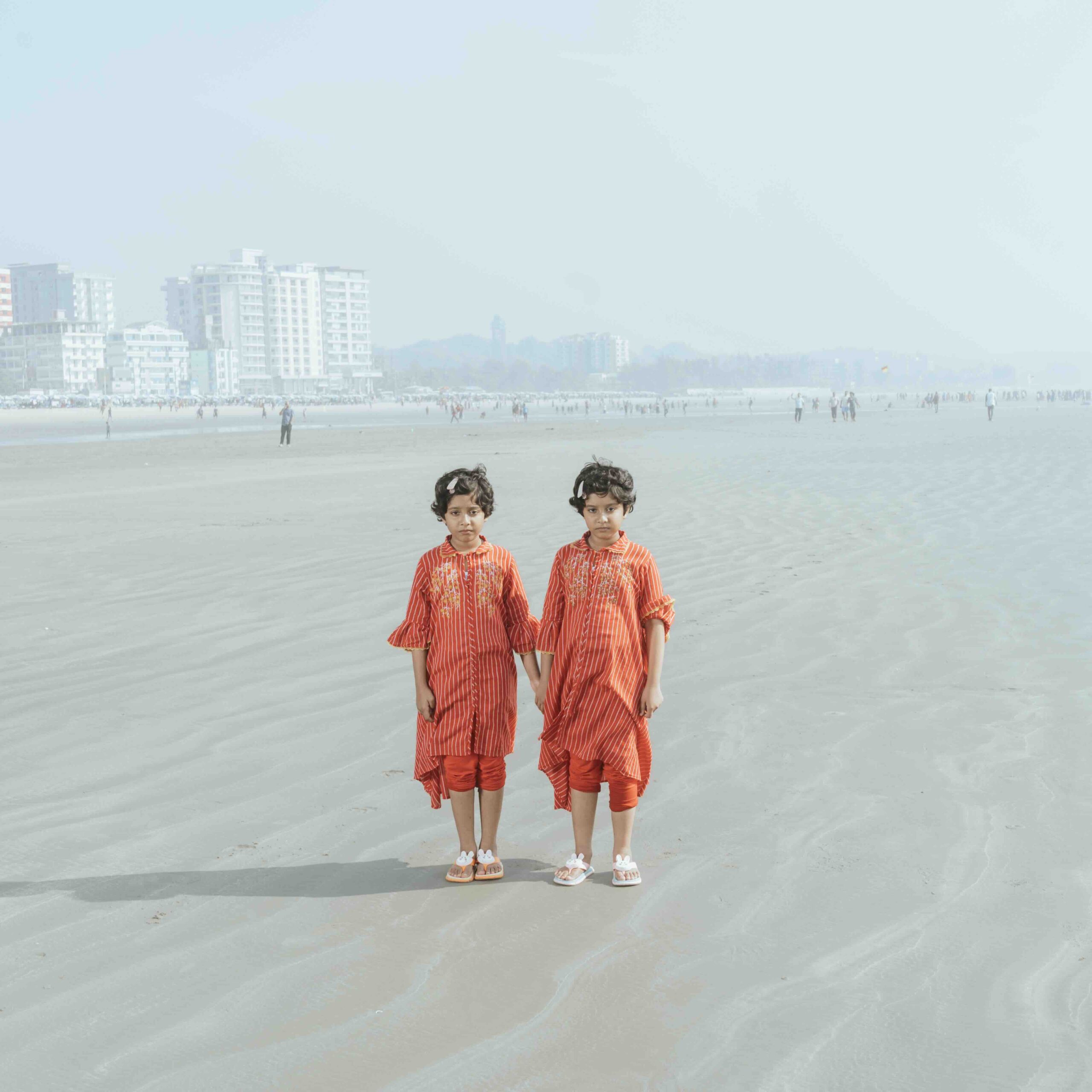
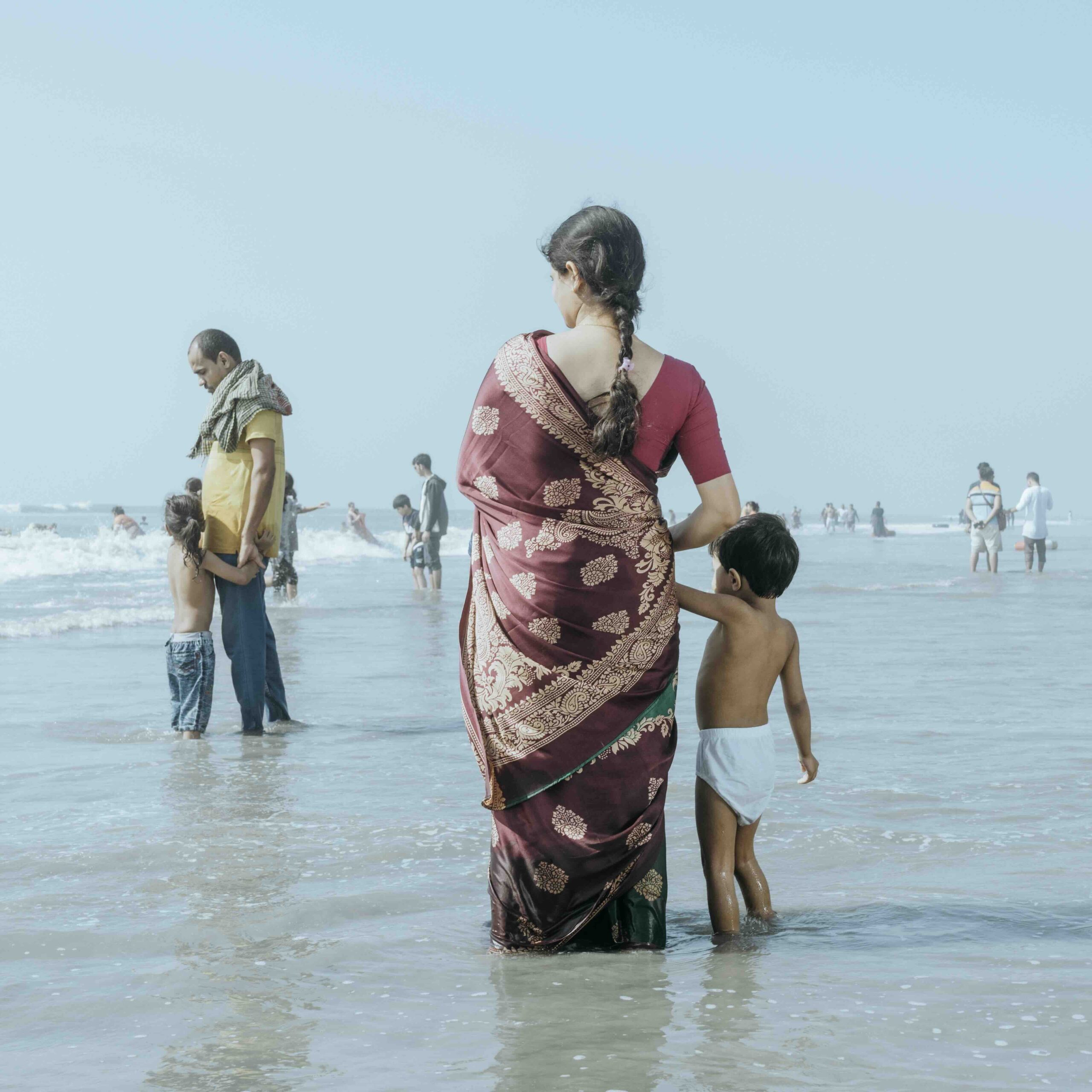
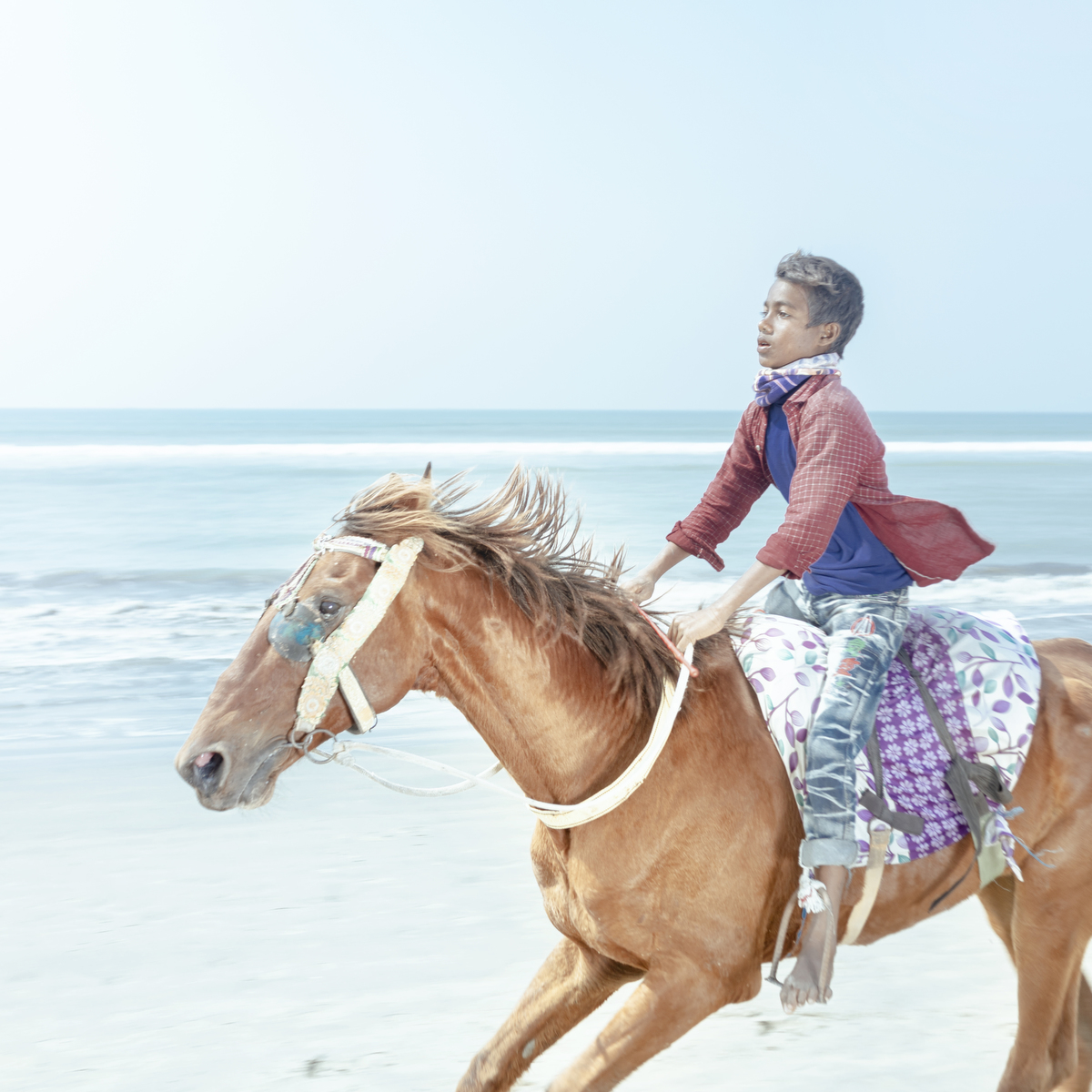
Ismail Ferdous first visited Cox’s Bazar as a young boy; it was his parents’ first holiday together.
Growing up in Dhaka, he returned throughout his youth, first with family, and later with friends. From early days playing in its sands to coming of age through the free roaming of adolescence, and now, decades on returning as an adult, this beach on the Bay of Bengal has remained an enduring presence in his life.
Cox’s Bazar is where people from across the districts, dialects, religions, and social strata of Bangladesh come together, as if in a diorama. Ordinary life is illuminated by the refraction of sunlight on the sea, animating the rich breadth of Bengali and indigenous cultural heritage.
Passing along Marine Drive reveals dense forests to the east, giving way to lush hills, and finally expansive sands to the west. What was once Angel Drop lookout has been replaced by enormous sandbags holding back rising tides. Where the highway descends towards Dolphin Circle, life in Cox’s Bazar carries on as it has. The air holds the scent of salt and affection.
The journey outward leads inward, and the further Ismail has traveled, the more he has come to perceive the landscapes of origins. Sea Beach is a touchstone and gateway. Waves repeat endless cycles of departure and return, as with every shoreline on Earth, and we find a communal crossroad here between vastness and intimacy.
Artist Bios
-
Ismail Ferdous (b. 1989), is a Bangladeshi photographer based in New York City. He is a member of Agence VU’ in Paris and a faculty member at ICP in New York. Raised in Dhaka, Ferdous is a self-taught photographer who cultivated his passion for photography while attending business school. He is deeply interested in human interest stories that resonate with the nuances of the contemporary world.
Some of his most influential works include a multidisciplinary project that addresses the devastating effects of the “fast fashion” industry on Bangladeshi workers through his documentary photos and films. His extensive work on migrations and refugees, spanning four continents, weaves narratives from Syria, Ukraine, Mexico, France, and Bangladesh. His work has also focused on the topic of race and diversity through the stories of South Asians and a portrait essay on immigrants working in the meat industry in the US.
Ferdous has participated in over 30 exhibitions at esteemed galleries, festivals, and museums, including Les Rencontres d’Arles. His work has appeared in the New York Times Magazine, the Washington Post, Geo, National Geographic, and M Le magazine du Monde, among others. Ismail has received numerous awards for his work, including the World Press Photo Award, Leica Oskar Barnack Award 2023, POYi, and the Getty Instagram Grant.
Organizations
-

For 50 years, Leica Galleries across the globe have existed as more than mere exhibition spaces. They are places for imagination, dialogue, and connection. Since the first Leica Gallery opened in Wetzlar in 1976, a global network of Leica Galleries has grown across continents. These galleries are united by the belief that images have the power to move people and change perspectives. The Leica Galleries celebrate the art of seeing and the power of photography. They have been bringing cultures, generations, and stories together, spanning borders, for half a century—reinforcing the idea that true photography is timeless and that seeing is still a universal language.